Well, I just saw that Chess Cafe posted a review, and reading it got me all excited about the book. I will be posting impressions as I go through it, but since I am just getting into it, I will quote a piece of the review for now. I chose the following partly because of the recent discussions on BDK's blog (and other places) about Watson vs. Aagaard, rule independence etc:
Chapter 7 (“The Concrete Approach”) is only seven pages long, but it may be one of the most important sections of the book. Lipnitsky demonstrates how dogmatic adherence to general principles can lead a player to defeat without his realization of what actually happened. “In any particular position,” he states, “the rejection of some laws (directives) merely makes way for the affirmation and success of others.” A player must be able to accurately assess, Lipnitsky states, “which laws – maxims, principles, rules – are valid in a given, specific case.” Here’s an excellent example, a practical case faced frequently:Thank you Chess Cafe for this detailed review. I am really looking forward to sinking my teeth into this classic and posting my own impressions. Stay tuned!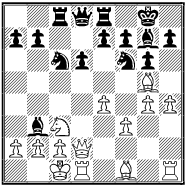
It is White to move, and Lipnitsky addresses two opposite approaches regarding how White should capture the bishop on b3:
(a) The superficial, dogmatic decision: White must capture towards the centre with a2xb3, since c2xb3? would open up the king, which is on the same file as the black rook. Besides, after c2xb3? Black would be left with an easily won king-and-pawn endgame if all the pieces were exchanged. Therefore, a2xb3!.
(b) The concrete, creative decision: in this position the chief, determining principle is the all-out attack on opposite wings. In the event of 13.axb3? Nb4!, threatening Qd8-a5, Black obtains an extremely strong attack. On the other hand after 13.cxb3! Black’s attack is very hard to develop, despite the placing of the rook and king opposite each other (For example: 13…Nb4 14.Kb1!).
White for his part will be able to continue his successful storming of the opponent’s kingside. In these circumstances Black’s extra pawn in the centre has no special significance.


